Hull Features and Your Thru-Hull Transducer
-
On stepped hull vessels , you can mount the transducer in front of the first step.
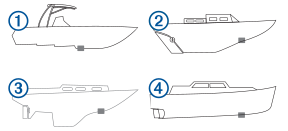
On full-keel vessels , you can mount the transducer at a slight angle aimed at the bow, not parallel to the centerline.
-
On fin-keel vessels , you can mount the transducer from 25 cm to 75 cm (10 to 30 in.) in front of the keel, and maximum 10 cm (4 in.) to the side of the centerline.
-
On vessels with displacement hulls , you can mount the transducer approximately 1/3 aft of the waterline length of the vessel from the bow, and from 15 to 30 cm (6 to 12 in.) to the side of the centerline.
-
Hulls with a deadrise of more than 5 degrees require a pair of thru-hull transducers , with one mounted on each side of the keel .
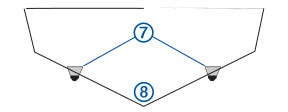
You must select the appropriate transducer for your hull deadrise angle so that the sonar beam sits at a 90-degree angle to the bottom.
-
If the deadrise angle of your mounting location exceeds 5 degrees, you can use fairing blocks to position the transducers parallel to the water line (Transducer Fairing Blocks).