Performance Measurements
These performance measurements are estimates that can help you track and understand your training activities and race performances. The measurements require a few activities using wrist-based heart rate or a compatible chest heart rate monitor. Cycling performance measurements require a heart rate monitor and a power meter.
These estimates are provided and supported by Firstbeat Analytics. For more information, go to Garmin.com/performance-data/running.
NOTE: The estimates may seem inaccurate at first. The watch requires you to complete a few activities to learn about your performance.
VO2 max.: VO2 max. is the maximum volume of oxygen (in milliliters) you can consume per minute per kilogram of body weight at your maximum performance ().
Predicted race times: The watch uses the VO2 max. estimate and your training history to provide a target race time based on your current state of fitness ().
HRV status: The watch analyzes your wrist heart rate readings while you are sleeping to determine your heart rate variability (HRV) status based on your personal, long-term HRV averages ().
Performance condition: Your performance condition is a real-time assessment after 6 to 20 minutes of activity. It can be added as a data field so you can view your performance condition during the rest of your activity. It compares your real-time condition to your average fitness level ().
Functional threshold power (FTP): The watch uses your user profile information from the initial setup to estimate your FTP.
Lactate threshold: Lactate threshold requires a chest heart rate monitor. Lactate threshold is the point where your muscles start to rapidly fatigue. Your watch measures your lactate threshold level using heart rate data and pace ().
VO2 max. is the maximum volume of oxygen (in milliliters) you can consume per minute per kilogram of body weight at your maximum performance. In simple terms, VO2 max. is an indication of athletic performance and should increase as your level of fitness improves. The Descent G2 device requires wrist-based heart rate or a compatible chest heart rate monitor to display your VO2 max. estimate. The device has separate VO2 max. estimates for running and cycling. You must run either outside with GPS or ride with a compatible power meter at a moderate level of intensity for several minutes to get an accurate VO2 max. estimate.
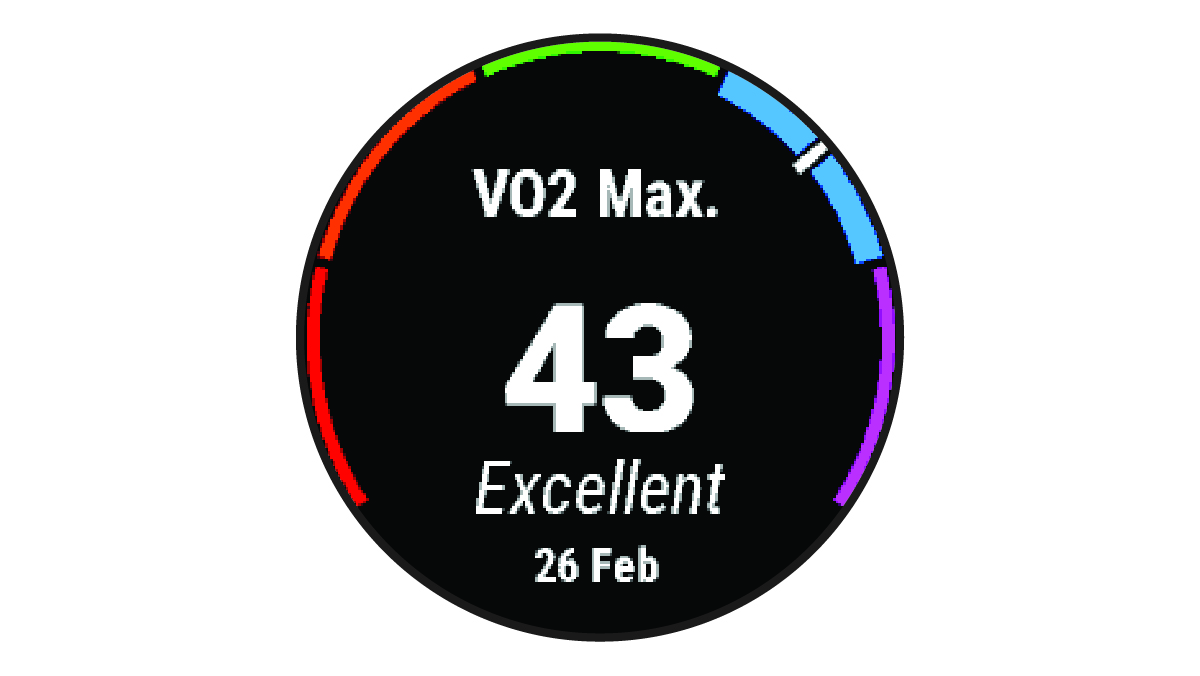
On the device, your VO2 max. estimate appears as a number, description, and position on the color gauge. On your Garmin Connect account, you can view additional details about your VO2 max. estimate, such as where it ranks for your age and sex.
|
|
Superior |
|
|
Excellent |
|
|
Good |
|
|
Fair |
|
|
Poor |
 Purple
 Blue
Blue Green
Green Orange
 Red
RedVO2 max. data is provided by Firstbeat Analytics. VO2 max. analysis is provided with permission from The Cooper Institute®. For more information, see the appendix (), and go to www.CooperInstitute.org.
Getting Your VO2 Max. Estimate for Running
This feature requires wrist-based heart rate or a compatible chest heart rate monitor. If you are using a chest heart rate monitor, you must put it on and pair it with your watch ().
For the most accurate estimate, complete the user profile setup (), and set your maximum heart rate (). The estimate may seem inaccurate at first. The watch requires a few runs to learn about your running performance. You can disable VO2 max. recording for ultra run and trail run activities if you do not want those run types to affect your VO2 max. estimate ().
- Start a running activity.
- Run for at least 10 minutes outdoors.
- After your run, select Save.
- Press UP or DOWN to scroll through the performance measurements.
Getting Your VO2 Max. Estimate for Cycling
This feature requires a power meter and wrist-based heart rate or a compatible chest heart rate monitor. The power meter must be paired with your watch (). If you are using a chest heart rate monitor, you must put it on and pair it with your watch.
For the most accurate estimate, complete the user profile setup () and set your maximum heart rate (). The estimate may seem inaccurate at first. The watch requires a few rides to learn about your cycling performance.
- Start a cycling activity.
- Ride at a steady, high intensity for at least 20 minutes.
- After your ride, select Save.
- Press UP or DOWN to scroll through the performance measurements.
Viewing Your Predicted Race Times
For the most accurate estimate, complete the user profile setup (), and set your maximum heart rate ().
Your watch uses the VO2 max. estimate and your training history to provide a target race time (). The watch analyzes several weeks of your training data to refine the race time estimates.
- From the watch face, press UP or DOWN to view the performance glance.
- Press START to view glance details.
- Press UP or DOWN to view a predicted race time.
- Press START to view predictions for other distances.
NOTE: The predictions may seem inaccurate at first. The watch requires a few runs to learn about your running performance.
Your watch analyzes your wrist heart rate readings while you are sleeping to determine your heart rate variability (HRV). Training, physical activity, sleep, nutrition, and healthy habits all impact your heart rate variability. HRV values can vary widely based on gender, age, and fitness level. A balanced HRV status may indicate positive signs of health such as good training and recovery balance, greater cardiovascular fitness, and resilience to stress. An unbalanced or poor status may be a sign of fatigue, greater recovery needs, or increased stress. For best results, you should wear the watch while sleeping. The watch requires three weeks of consistent sleep data to display your heart rate variability status.
|
Color Zone |
Status |
Description |
|
|
Balanced |
Your seven-day average HRV is within your baseline range. |
|
|
Unbalanced |
Your seven-day average HRV is above or below your baseline range. |
|
|
Low |
Your seven-day average HRV is well below your baseline range. |
|
No color |
Poor |
Your HRV values are averaging well below the normal range for your age. |
You can sync your watch with your Garmin Connect account to view your current heart rate variability status, trends, and educational feedback.
Heart Rate Variability and Stress Level
Stress level is the result of a three-minute test performed while standing still, where the Descent device analyzes heart rate variability to determine your overall stress. Training, sleep, nutrition, and general life stress all impact how a runner performs. The stress level range is from 1 to 100, where 1 is a very low stress state and 100 is a very high stress state. Knowing your stress level can help you decide if your body is ready for a tough training run or yoga.
Viewing Your Heart Rate Variability and Stress Level
This feature requires a Garmin chest heart rate monitor. Before you can view your heart rate variability (HRV) stress level, you must put on a heart rate monitor and pair it with your device ().
TIP: Garmin recommends that you measure your stress level at approximately the same time and under the same conditions every day.
- If necessary, press START, and select Add > HRV Stress to add the stress app to the apps list.
- Select
 to add the app to your list of favorites.
 - From the watch face, press START, select HRV Stress, and press START.
- Stand still, and rest for 3 minutes.